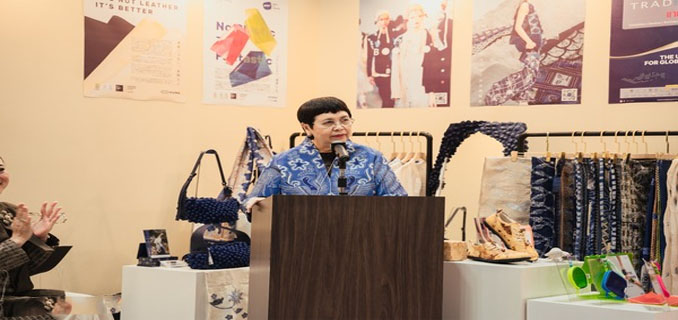
Jam Waktu – The Indonesian government has once again demonstrated its commitment to promoting the national creative industry on the global stage. Through her diplomatic representative in Japan, the Indonesian Ambassador to Japan, Kartini Sjahrir, officially opened the Indonesian Pavilion at Fashion World Tokyo 2026. The pavilion’s presence is a strategic step to showcase the nation’s best work and open up opportunities for global business collaboration.
Fashion World Tokyo is one of the largest fashion industry exhibitions in Japan, attended by industry players from various countries. In this forum, Indonesia leverages the opportunity to showcase the richness of design, product quality, and cultural identity that characterizes the national creative industry.
In her remarks, Ambassador Kartini emphasized that Indonesia’s participation in this event is not merely an exhibition, but part of an ongoing effort to enhance the competitiveness of national products in the international market. She also praised several Indonesian products that have won global recognition, including prestigious design awards in Japan.
The Indonesian Pavilion showcases a variety of superior products, ranging from ready-to-wear fashion, traditional fabrics, accessories, and handicraft-based lifestyle products. Many of these products embody the concept of sustainable fashion, which is now a global trend. This demonstrates that Indonesian creative industry players are not only able to compete aesthetically, but also in terms of innovation and environmental awareness.
Participation in Fashion World Tokyo 2026 also serves as an important platform for Indonesian businesses to build international networks. Various business matching meetings will be held between Indonesian industry players and buyers, distributors, and investors from Japan and other countries. These activities are expected to open wider export access and strengthen Indonesia’s position in the global supply chain.
Ambassador Kartini emphasized that Japan is a highly potential market for Indonesian products, particularly due to the Japanese public’s high appreciation for quality, detail, and cultural value. Therefore, the presence of the Indonesian Pavilion is expected to strengthen the positive image of national products in the eyes of Japanese consumers.
Furthermore, the pavilion also serves as an effective means of cultural diplomacy. Through fashion and creative products, Indonesia can introduce its rich and diverse cultural identity to the world. Each showcased work not only has economic value but also tells stories about traditions, local wisdom, and the creativity of the Indonesian people.
The involvement of small and medium enterprises (SMEs) in this event was also highlighted. Many SMEs were given the opportunity to compete internationally, something they would have previously struggled to achieve without the support of the government and strategic partners. This aligns with the government’s efforts to promote economic inclusivity and equal opportunities for all business actors.
Furthermore, design innovation was a key strength of the exhibits. The Indonesian products on display combined traditional elements with modern touches, capturing the interest of the global market without losing their local identity. This approach is considered an effective strategy for winning competition in the highly dynamic international fashion industry.
Several visitors and industry players in attendance responded positively to the Indonesian Pavilion. They noted the high quality and unique designs of the products on display. This opens up significant opportunities for long-term collaboration, whether in the form of distribution, co-production, or investment.
Indonesia’s participation in Fashion World Tokyo 2026 also reflects the importance of cross-sector collaboration. The government, industry players, creative communities, and international partners are working together to create an ecosystem that supports the growth of the creative industry. This collaboration is key to facing global challenges and capitalizing on existing opportunities.
More broadly, this step is also in line with Indonesia’s vision to become a global hub for the creative industry. With its vast human resource potential, rich culture, and ever-growing creativity, Indonesia has a significant opportunity to strengthen its position in the global market.
However, challenges remain. International quality standards, production consistency, and adaptability to global trends must be continuously improved. Therefore, participation in international events like this serves not only as a promotional platform but also as a learning platform for industry players.
Ambassador Kartini hoped that the Indonesian Pavilion would serve as a starting point for broader collaboration in the future. She also encouraged all parties to continue supporting local products so they can compete globally.
“Through this event, we are not only promoting products, but also building trust and paving the way for sustainable collaboration,” she said at the inauguration.
With increasingly open access to international markets, it is hoped that Indonesian products will become increasingly recognized and sought after by global consumers. This will not only impact export growth but also overall national economic growth.
Going forward, the government is committed to continuing to support creative industry players through various programs, including facilitating international exhibitions, training, and strengthening the business ecosystem. These steps are expected to encourage more Indonesian businesses to go global.
Indonesia’s participation in Fashion World Tokyo 2026 is proof that Indonesia’s creative products have great potential to compete internationally. With the right support and strong collaboration, it is possible that Indonesia will become a major player in the global fashion industry.
Through the Indonesian Pavilion, the world is increasingly recognizing that Indonesian creativity and product quality can stand on par with other countries. This isn’t just about fashion, but about identity, innovation, and the future of Indonesia’s creative industry on the global stage.