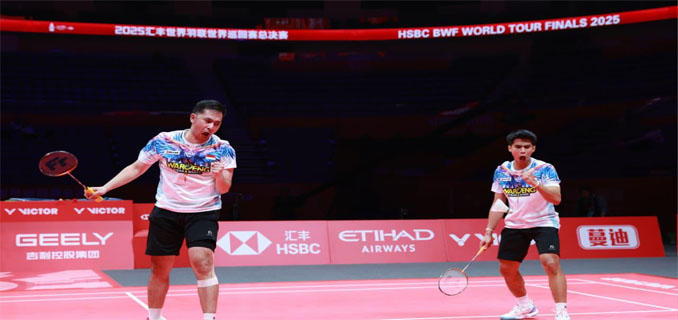
Jamwaktu.com – The Indonesian contingent’s struggle at the 2025 BWF World Tour Finals remains challenging after the men’s doubles pair of Sabar Karyaman Gutama and Moh Reza Pahlevi Isfahani, who had put on an impressive performance on the first day, were defeated by the world’s number one pair in their second group stage match at the Hangzhou Olympic Sports Center Gymnasium, China, on Thursday (12/18/2025).
Sabar/Reza, who defeated Malaysia’s Man Wei Chong and Tee Kai Wun in their opening match, were unable to replicate that performance against the South Korean pair of Kim Won-ho and Seo Seung-jae the currently world number one men’s doubles pair. In this Group A duel, Sabar/Reza lost in straight games, 20-22 and 17-21. The top-seeded Indonesian pair put up a fierce fight in the first game, even taking a temporary lead, but their opponents’ pressure and consistent play ultimately determined the outcome.
Tight Match Against World Number 1
The match, which lasted approximately 42 minutes, demonstrated the high quality of both pairs. Kim/Seo were able to maximize their experience and team coordination to remain dominant in crucial moments, especially as the match entered the deciding points phase. Despite this, Sabar/Reza displayed a strong level of competitiveness, applying pressure from start to finish, at least in several intervals.
In the end, however, the two-time 2025 SEA Games gold medalists were unable to find a rhythm that could surprise the Korean pair. This result undoubtedly put emotional pressure on the Indonesian contingent, as the chance to advance to the semifinals was still open with a decisive victory over another pair in the deciding match, but it would be a tough battle.
Day One Performance and Further Hopes
Previously, on the first day of the tournament, Sabar/Reza had garnered positive attention after winning over Malaysia in the opening match. This result temporarily put them at the top of the men’s doubles Group A standings, despite the tight competition in the group, which featured the world’s top-ranked pair.
This defeat to the world’s number one doubles pair doesn’t completely rule out Indonesia’s chances of advancing further, but it demonstrates the immense challenges at the World Tour Finals. In this group stage, every match has a significant impact on their chances of advancing to the semifinals. Sabar/Reza still have a deciding match against Taiwanese pair Chiu Hsiang-chieh/Wang Chi-lin, which represents their last chance to maintain their hopes of advancing to the next round.
Pressure on the Indonesian Contingent
This defeat adds to the Indonesian team’s challenging second day of the World Tour Finals. Besides Sabar/Reza, several other representatives also experienced less than ideal results. For example, in the mixed doubles, Jafar Hidayatullah/Felisha Pasaribu lost their first two matches, further diminishing their chances of advancing to the semifinals. In the women’s and men’s singles, players like Putri Kusuma Wardani and Jonatan Christie also suffered defeats to strong opponents.
This situation demonstrates that the Indonesian team’s dominance is not easy to maintain in a competition featuring only the world’s eight best representatives in each event. Technical excellence and consistent play are crucial factors, as Indonesia secured a crucial victory on the opening day. However, pressure from top competitors remains high.
Looking Ahead to the Decisive Match
Despite facing intense pressure, Sabar/Reza are determined to deliver their best performance in the decisive match. In a brief post-match interview, Reza acknowledged the quality of their opponents and the importance of maintaining high levels of focus and strategy if they are to remain competitive in this tournament.
Meanwhile, the Indonesian contingent remains hopeful that other representatives in the tournament, including the men’s singles and men’s doubles teams, will achieve positive results. The Indonesian team’s overall performance at the World Tour Finals is expected to reflect the strength of national badminton, despite the intense competitive pressure at the elite level. This will serve as both a test and a learning experience in preparation for future major competitions, including the Olympics and the World Championships.