
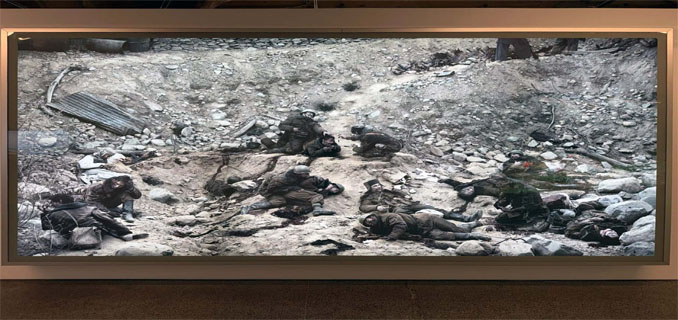
Jamwaktu.com – Amidst the global discourse on fact and fiction in the post-truth era, the work of Canadian photographer Jeff Wall has once again come into the spotlight for radically challenging conventional notions of visual truth. Through meticulously designed photographs and dramatic mise-en-scène, Wall not only creates aesthetically pleasing images but also forces viewers to question what they are actually seeing and what they perceive as reality.
Jeff Wall, known for his large-scale photographic productions that take months or even years to prepare, often gathers references from real-life experiences and then reconstructs the scene in a studio or tightly controlled location. This method goes beyond simply taking photographs; he operates as a film director, stage designer, and painter all at once. His approach, which he terms cinematographic or near-documentary, distances him from spontaneous journalistic photography, while maintaining a sense of connection to reality.
In his work, Wall blurs the lines between documentary and fiction. For example, his iconic photograph, Dead Troops Talk (1992), depicts Soviet troops rising from the dead after a fictional attack a scene that visually feels incredibly real despite never having occurred. This composition is not simply a simulation of events, but a manipulation of the visual experience that forces the viewer to question what constitutes truth in an image.
Wikipedia
Jeff Wall’s practice has become increasingly relevant in an era where technologies like deepfakes and social media are blurring the lines between fact and fiction. Many art critics have cited Wall as a pioneer in expanding the role of contemporary photography, not as a passive witness to events, but as a creator of narratives conscious of their own visual constructions. According to recent reviews, Wall’s work feels not only documentary-like but also a provocation against the notion of photography as objective evidence.
Although the term staged photography often appears in discussions of his work, Wall himself tends to reject the label. He prefers to describe his work as images that possess cinematic truth a form of truth that is not literal but rather involves questions, feelings, and interpretations. In his approach, nothing is fake Every element in a photograph occurs within a context consciously designed and chosen by the artist.
The artist believes that photography is inseparable from interpretation and creative control. He believes that viewers always bring their own visual culture, as well as assumptions about how photographs should represent life. By meticulously crafting scenes and visual dialogue, Wall forces viewers to reconsider this expectation that photographs are objective representations of reality. Instead, he demonstrates that every image has an inherently subjective layer, even in what appears to be documentary.
Jeff Wall’s challenge is not only aesthetic, but also epistemological: how we know what we see. In the post-truth era, when photos and videos can be easily manipulated, Wall’s work reminds viewers that even the most beautiful visual representations have a construction behind them. Thus, Wall’s works do not simply photograph the world, but reflect it back to us in a more conscious and critical way, opening up a dialogue about the boundaries between fact and fiction in contemporary visual imagery.