
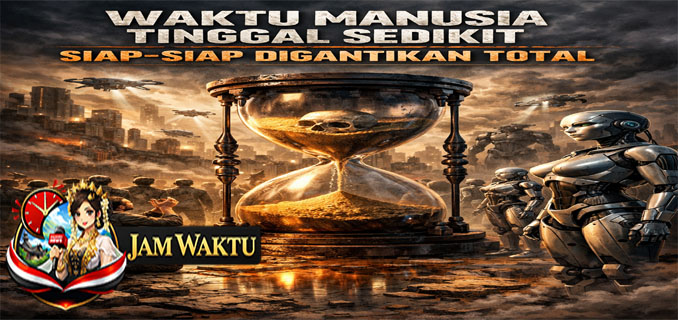
Jamwaktu.com – The development of artificial intelligence (AI) and robotics technology is no longer just a science fiction story. The world is entering a phase of major transformation, where machines are not only assisting humans but are beginning to take over roles previously considered exclusively human. A major question arises: is this the end of human dominance, or the beginning of a new, more advanced civilization?
In recent years, the impact of AI on the world of work and daily life has become increasingly apparent. Many global companies are starting to use AI to increase efficiency, reduce costs, and speed up work processes. However, the consequences of this change cannot be ignored. According to a World Economic Forum report, approximately 92 million jobs are expected to be replaced by technology by 2030, although approximately 170 million new jobs will also be created. These changes demonstrate that technology is not only destroying jobs but also creating new, unprecedented opportunities.
The Inevitable Wave of Automation
Automation has penetrated various sectors, from manufacturing and banking to the creative industries. Machines are now capable of performing administrative tasks, data analysis, and even writing and producing digital content. It’s estimated that around 34 percent of work tasks worldwide could be completely automated in the next few years.
Furthermore, McKinsey research shows that up to 30 percent of current work hours could be replaced by automated technology by 2030. This means millions of workers will have to adapt to a new reality where old skills are no longer sufficient.
In fact, the impact is already being felt now. A recent study found that tens of thousands of jobs have been lost due to the adoption of AI, while large companies are starting to lay off employees as part of their digital transformation.
This phenomenon is causing global concern. Many workers are beginning to question their future, while younger generations are reconsidering their career choices to avoid fields vulnerable to automation.
Not Just Replacement, But Transformation
While many jobs are at risk of disappearing, experts emphasize that technology doesn’t completely replace humans. Instead, AI often transforms the way humans work. This technology takes over routine and repetitive tasks, freeing humans to focus on work that requires creativity, empathy, and strategic thinking.
In fact, despite the rapid advancement of AI, approximately 66 percent of business tasks are still performed by humans, demonstrating that human roles remain crucial.
Furthermore, AI is also creating new professions such as AI specialists, data analysts, and robotics engineers. In fact, some reports predict that AI could increase global productivity and generate significant economic growth.
In other words, this is not the end of the human role, but rather the beginning of a new era of work where humans and machines work side by side.
Threat or Opportunity?
The debate about the future of humanity in the AI era continues. Some see AI as a threat that could eliminate millions of jobs and widen economic inequality. Others see it as an opportunity to create a more efficient and prosperous world.
Experts also emphasize that humans’ ability to adapt will be a determining factor. Skills such as creativity, emotional intelligence, complex problem-solving, and adaptability will become increasingly important in the future.
History has shown that every technological revolution, from the steam engine to the computer, has brought profound changes. However, humans have always managed to adapt and find new roles.
The Beginning of a New Civilization
Today, the world stands at a crucial crossroads. Machines are becoming increasingly intelligent, and the boundaries between human capabilities and technology are blurring. However, the future will not be entirely determined by technology, but rather by how humans choose to use it.
Instead of replacing humans entirely, AI will likely be a tool that extends human capabilities. The civilization of the future may not be about humans versus machines, but about collaboration between the two. The biggest question is no longer whether machines will replace humans, but whether humans are ready to evolve alongside technology. Because ultimately, the future belongs not to machines or humans alone but to those who can adapt to change.