
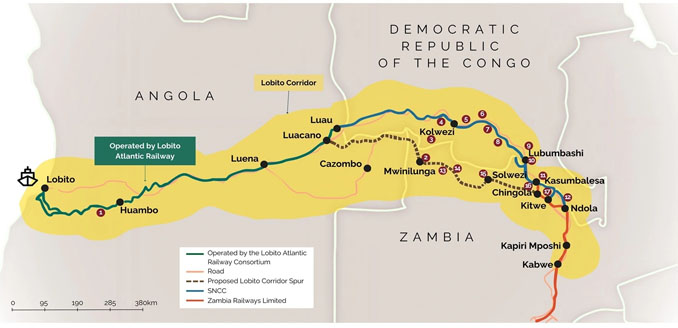
Jamwaktu.com – The Lobito Corridor, one of Africa’s most ambitious infrastructure projects, is currently attracting global attention due to its increasingly strategic role in connecting cross-border supply chains. Located in southern Africa and stretching from the port of Lobito in Angola to the Democratic Republic of Congo and Zambia, the corridor is projected to become a key route for regional and global trade. With significant investment, infrastructure improvements, and the involvement of international partners, the Lobito Corridor is seen as key to new economic growth in the region.
Increasingly Integrated Transportation Infrastructure
The Lobito Corridor is supported by the Benguela Railway, which has undergone a major revitalization in recent years. This modernization includes improvements to the track, loading and unloading facilities, and freight transport systems. The railway facilitates the movement of minerals, industrial raw materials, and agricultural commodities from Zambia and Congo to the Port of Lobito on the Atlantic.
With significantly faster travel times than the traditional route through the Port of Durban in South Africa, the Lobito Corridor offers significant logistics cost savings. This efficiency makes the route highly attractive to mining and heavy industry companies requiring rapid access to global markets.
Furthermore, the Angolan government, along with international partners, has expanded port capacity, built modern logistics terminals, and created new industrial parks along the corridor. These steps strengthen transportation integration and increase investment attractiveness.
Accelerating Infrastructure Investment from Global Partners
The Lobito Corridor has also attracted the attention of major countries and international financial institutions. The governments of the United States, the European Union, and several global investment institutions have expressed their commitment to supporting the corridor’s development.
These investments include not only railway improvements but also the construction of supporting infrastructure such as roads, industrial parks, energy facilities, and logistics centers. These projects aim to make the corridor a key route connecting African commodity producers with international markets through efficient sea access.
With increased connectivity, the Lobito Corridor is expected to attract more global companies, including those operating in the manufacturing, mining, renewable energy, and mineral processing technology sectors.
Economic Impact for Angola, Zambia, and the Democratic Republic of the Congo
The growth in business activity along the Lobito Corridor has had a significant impact on the countries through which it passes. Angola, as the main gateway through the port of Lobito, benefits from increased exports and a strengthened logistics sector. Furthermore, the development of new industrial parks creates jobs and business opportunities for local communities.
In Zambia and the Democratic Republic of Congo, this corridor serves as a vital route for mineral exports, particularly copper and cobalt, vital commodities for the battery and green technology industries. With faster and cheaper distribution, national incomes are expected to increase, while strengthening these countries’ competitiveness in the global market.
Economists predict that the Lobito Corridor has the potential to be a major driver of Southern Africa’s economic transformation in the coming years. This route will enable stronger economic integration and increase regional trade volumes.
New Business Opportunities Along the Lobito Corridor
In addition to the logistics and mining sectors, this corridor also opens up business opportunities in other sectors such as renewable energy, manufacturing, construction, and financial services. The development of new logistics centers requires a stable energy supply, driving investment in solar power plants and other clean energy sources.
The food, agricultural processing, and construction materials industries are also expected to grow rapidly due to high demand from companies operating around the corridor. Easy access to ports and railways makes this area a favorite for businesses requiring fast and efficient distribution.
Challenges Remaining to Be Addressed
Despite its significant potential, the Lobito Corridor also faces a number of challenges. Several issues related to cross-border regulations, bureaucracy, and political stability are expected to be resolved to ensure the corridor’s smooth operation. Furthermore, the uneven quality of infrastructure in several areas still requires additional investment.
The security of railway lines and industrial areas is also a concern. The government, along with international partners, continues to collaborate to ensure high security standards to ensure the smooth flow of logistics.
Conclusion
The Lobito Corridor now stands as a strategic hub for business activity, playing a crucial role in supporting supply chains, expanding infrastructure investment, and driving economic growth in Southern Africa. With global support, increased connectivity, and abundant commodity potential, this corridor is expected to become one of the world’s most vital economic arteries in the coming years.