
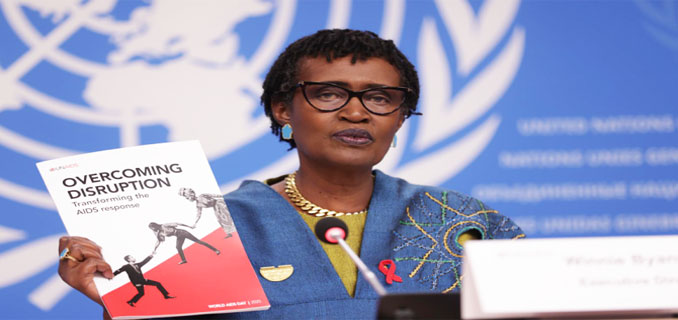
Jamwaktu.com – Every December 1st, the world commemorates World AIDS Day, a global day to remember the fight against HIV/AIDS, remember those lost, and renew collective commitment. The year 2025 feels particularly precarious, as the global response to HIV faces major shocks: funding cuts, a rollback of human rights, and a reduction in prevention services.
At this time, Winnie Byanyima’s message takes on new power as an urgent call to action, upholding equity, and putting communities at the center of efforts to ensure decades of progress are not lost.
A Portrait of a Global Crisis: Shrinking Funds, Disrupted Services
A recent report from UNAIDS revealed that the global response to HIV in 2025 faces the most serious setback in decades. Sudden cuts in international aid, estimated at 30–40% compared to 2023, have devastated prevention and treatment services in many low- and middle-income countries.
As a result, clinics have closed, health-care workers have lost their jobs, and crucial programs such as PrEP prevention, community services, counseling, and testing have been discontinued or reduced. The challenge is compounded by the fact that, amidst this crisis, discrimination, anti-LGBTQ+ laws, and stigma still hinder access to services for vulnerable populations.
Winnie Byanyima stated that behind the numbers and statistics are human beings: babies missed out on screening, adolescent girls without access to prevention, and communities suddenly deprived of services.
“The funding crisis has exposed the fragility of our hard-fought progress.”
2025 Theme: “Overcoming Disruption, Transforming the AIDS Response” – A Time for Transformation
The theme for World AIDS Day 2025 is “Overcoming disruption, transforming the AIDS response,” a global call to rise above the shock and build a more equitable, inclusive, and sustainable response.
In a commemoration at UNAIDS headquarters in Geneva, along with the World Health Organization (WHO) and The Global Fund, Byanyima emphasized that human progress against AIDS could be lost if the world retreats now.
He called on countries, donors, and communities to make a choice: either let progress be undone, or unite to end AIDS as a public health threat by 2030.
Equality, Human Rights, & Community-Friendly Services: Byanyima’s Core Message
According to Byanyima, to address this crisis, solutions cannot be merely technical, such as the distribution of PrEP or medication, but must be structural: protecting human rights, eliminating discrimination, and empowering communities.
He called for HIV prevention and care services to be provided inclusively without discrimination against young women, key populations such as LGBTQ+ people, sex workers, drug users, or other minorities.
Community-led services are considered crucial. In many cases, community-based services are the only way to reach marginalized populations, build trust, and ensure safe and confidential access.
Byanyima warned that without political courage, investment, social justice, and global solidarity, many lives will be affected, and the global target of “zero new infections, zero stigma, zero AIDS deaths” will be difficult to achieve.
Hope & Concrete Actions: Innovation, Domestic Funding, and Global Solidarity
Despite the crisis, there are glimmers of hope. Some countries are increasing domestic funding for HIV, reducing reliance on foreign aid, and designing sustainable health roadmaps.
New preventive drugs, such as long-acting injectables, are becoming available in some places, raising hopes that prevention will become more accessible to the most vulnerable.
However, all of this will only be meaningful if the world truly chooses solidarity, protects human rights, and listens to the most affected communities. Byanyima calls on all stakeholders: governments, donors, civil society organizations, communities, and individuals to unite and take concrete action.
Why It Matters to the World & Indonesia (or Your Country)
Given the current crisis, it is crucial that every country, including those in the Asia-Pacific, review their strategies: ensuring that HIV services are available, inclusive, and sustainable; protecting the rights of vulnerable groups; and supporting local communities.
For individuals: this commemoration is a call for solidarity, to not let stigma and discrimination prevail. To support human rights, access to care, and appropriate education about HIV.
Conclusion: The Choice Between Regression or Transformation
World AIDS Day 2025 marks a critical turning point. The funding crisis and the rollback of rights have destabilized the global response to HIV. However, with Winnie Byanyima’s strong message emphasizing equality, rights, prevention, and community services, the world still has an opportunity to choose the right path: transformation.
If the world unites, makes bold decisions, and puts communities at the center of the response, the ultimate goal of ending AIDS as a public health threat by 2030 is within reach. Now is not the time to retreat; rather, it is time to act with determination, empathy, and solidarity.