Jamwaktu.com – The development of artificial intelligence (AI) technology is increasingly penetrating the retail sector. One innovation being tested and implemented in various countries is AI anti-theft technology. In a recent report, a BBC reporter conducted a live test of an AI anti-theft system in a retail store to assess the technology’s accuracy and its impact on consumers and store security.
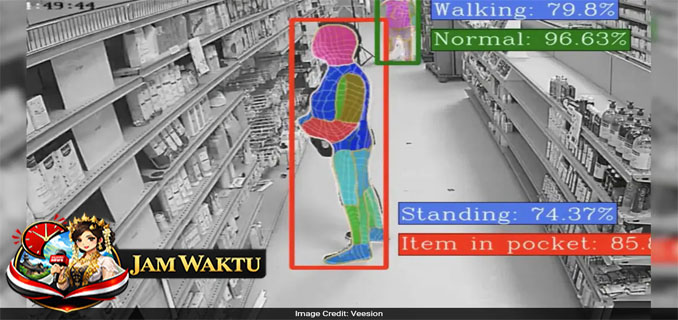
This technology is designed to automatically detect suspicious behavior through surveillance cameras connected to the AI system. Unlike conventional CCTV, AI anti-theft not only records images but also analyzes body movements, behavioral patterns, and customer interactions with items on shelves. The system then alerts store staff if potential theft is detected.
In tests conducted by the BBC reporter, the AI was able to recognize several patterns considered risky, such as repeated hand movements into a bag, attempts to hide items, or prolonged pacing in a specific area. The BBC reporter simulated several scenarios, from picking up items and pretending to put them in a pocket to standing too long in front of a shelf. As a result, the AI system immediately flagged the activity as ‘suspicious behavior’ and sent a notification to the staff’s monitoring screen.
However, the trial also revealed another side of this technology. In some cases, the AI was recorded as issuing false positive alerts to customers who had no actual intention of stealing. For example, customers who took a long time comparing products or putting their phones in their bags were detected as potential thieves. This raises questions about the extent to which AI accuracy can be relied upon without harming consumers.
The system developers interviewed by the BBC acknowledged that AI anti-theft technology is still being refined. They stated that the system operates based on probabilities and data patterns, not absolute certainty. Therefore, AI only functions as a monitoring tool, while the final decision remains in the hands of humans, namely security staff or store managers.
From a security perspective, the use of AI is considered capable of reducing retail theft, which has historically been a significant loss for businesses. With real-time monitoring and automated analysis, stores can respond more quickly without having to increase the number of security personnel. Furthermore, the presence of AI is also claimed to prevent theft before it occurs, because the system detects suspicious intent early on.
However, the impact on consumers was a major concern in the BBC report. Several privacy observers believe this technology has the potential to create discomfort for customers. They worry that AI-based surveillance could lead to privacy violations, discrimination, or misunderstandings that harm certain individuals.
In response, the store manager who participated in the trial emphasized that the AI system does not permanently store customers’ personal data. Recordings and analysis are used only for security purposes and comply with applicable data protection regulations. Information to consumers is also openly posted on a notice board that the store area is being monitored by the AI system.
The BBC reporter concluded that AI anti-theft technology offers significant potential for improving retail security, but still presents serious challenges related to accuracy and ethics. The success of this technology depends heavily on the balance between protecting businesses and the rights and convenience of consumers.
Going forward, experts believe that the implementation of AI in retail stores must be accompanied by clear regulations, transparency to the public, and regular evaluation of its impact. Without proper oversight, technology intended to improve security risks creating new problems in society.
The trial conducted by the BBC reporter provides an early glimpse of how AI is slowly changing the face of the retail industry, while also reminding us that technological innovation must always go hand in hand with social responsibility.