
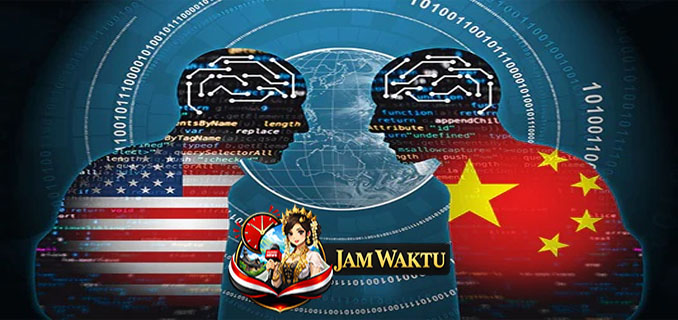
Jamwaktu.com – Relations between China and the United States (US) continue to experience complex dynamics influenced by the development of advanced technology. From artificial intelligence (AI) to semiconductors and digital sovereignty, the competition between these two global powers is now not just about diplomacy or economics, but also about technological dominance that will determine the global architecture of the 21st century.
At the end of 2025, China officially implemented a new regulation requiring chip manufacturers to use at least 50% domestic equipment in new semiconductor production capacity. This measure was taken to accelerate technological resilience amidst pressure and technological sanctions from the US, which remains one of the world’s most dominant chip producers.
Competition in the AI realm is also intensifying. The AI industrial policies of both countries now reflect that digital innovation is not only about technology but also an integral part of national strength. According to some experts, AI has transformed from a mere technological innovation into a new geoeconomic battleground, where both countries seek to secure superiority in future data and computing systems.
The issue of digital sovereignty has also become a strategic arena in China-US relations. China is developing a national digital model that emphasizes domestic data control and security, while the US, with its powerful technology companies, continues to push for a model of global openness and interoperability. These differing approaches frequently emerge in international forums and become a point of tension and even a tug-of-war in trade and digital policy negotiations.
Behind this rivalry, some analysts believe that technological competition can actually open up new opportunities. The competition between the two countries for leadership in digital innovation, including AI, cloud computing, and the digital economy, is spurring significant investment and accelerated innovation, with far-reaching impacts on global technological development.
However, this competition is not without serious challenges. US technology export restrictions, including controls on advanced components and production equipment, have prompted China to accelerate the development of its domestic technology ecosystem. This has prompted major Chinese tech cities like Shenzhen and Shanghai to collaborate with the government to strengthen local innovation capabilities and reduce dependence on foreign technology.
The digital transformation of China’s industrial sector also shows a rapid growth trend in digital applications, cloud computing, 5G, and industrial data. The country’s digital infrastructure continues to expand, including the expansion of 5G networks and data centers that support the booming digital economy.
From the US side, legislative support such as the CHIPS and Science Act provides significant incentives for high-tech research and production, particularly semiconductors and advanced research facilities, as part of a strategy to maintain its global position in the era of advanced technology.
The global implications of this competition are profound. On the one hand, a technology race between China and the US could accelerate the adoption of innovations worldwide. On the other hand, protectionist policies and strategic competition could lead to fragmentation of technology markets, creating uncertainty for international technology alliances and global supply chains.
Analysis shows that the new era of China-US competition is more than just a bilateral relationship; it is a determining factor in shaping the future of global technology, including aspects of ethics, security, and the broader international rules of the game. Investors, policymakers, and the global technology community are now closely monitoring these developments, as their impact will be felt far beyond the two countries, particularly in the digital, economic, and global security spheres.